A roofline can look carefully designed from the street, then lose its impact with a rounded, undersized gutter running beneath it. European style square seamless eavestroughs solve that mismatch by combining a crisp architectural profile with dependable water control. For contemporary homes across the Greater Toronto Area, they provide a clean finish that supports both curb appeal and long-term protection.
The visual difference is immediate, but the practical role is just as important. An eavestrough system collects roof runoff, directs it toward downspouts, and helps keep water away from fascia, soffits, exterior walls, walkways, and foundations. The right system must suit the roof layout, the property’s drainage plan, and the amount of water it needs to handle during heavy Ontario rain.
What Defines European Style Square Seamless Eavestroughs?
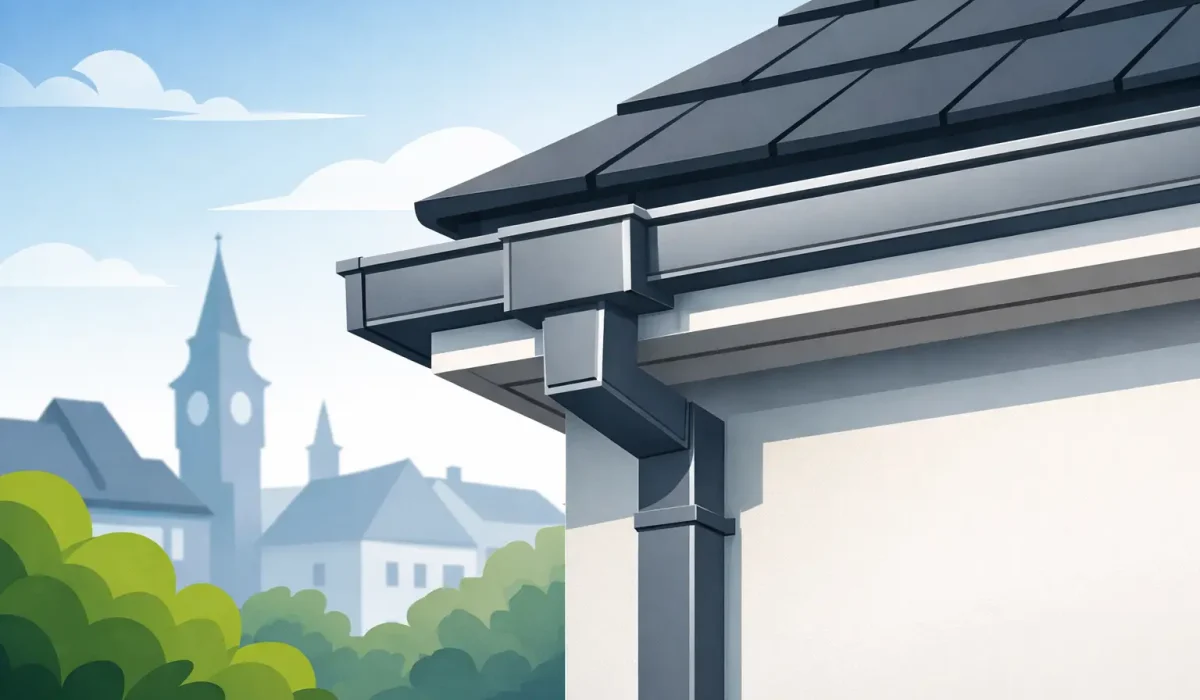
The defining feature is the square, contemporary profile. Rather than the curved front commonly seen on traditional K-style gutters, square eavestroughs use straight lines and sharper edges that complement modern cladding, flat roof elements, bold fascia details, and clean window geometry.
They are formed on site to match the required run length, minimizing joints along the eaves. Fewer connections create a more refined visual line and reduce the number of locations that can require attention over time. End caps, corners, outlets, hangers, and downspouts are still necessary components, so installation precision remains essential.
For custom homes, this system often becomes part of a larger exterior composition. It can be coordinated with aluminum fascia, vented soffit, metal cladding, ACM panels, cedar accents, or modern vinyl siding. The goal is not to make drainage hardware the focal point. It is to give the roof edge a deliberate, finished appearance while ensuring it performs when the weather turns.
Why the Square Profile Works on Modern GTA Homes
Square eavestroughs suit homes with strong horizontal lines and minimal trim. On a contemporary elevation, a rounded gutter can appear separate from the architecture. A square profile sits closer to the visual language of the home, particularly where the design includes black-framed windows, dark fascia, linear siding panels, or crisp aluminum details.
Color selection matters as much as profile. Matching the eavestrough to the fascia creates a continuous roofline. Choosing a contrasting color can define the edge of the roof and work well on light stucco, pale siding, or natural wood finishes. A professional installer can help determine whether the system should blend in or provide intentional contrast.
This style is not limited to luxury new construction. It can also elevate an exterior renovation where homeowners are replacing worn soffits, fascia, siding, and drainage components at the same time. Installing the complete roofline system together produces better alignment, consistent color, and fewer compromises between old and new materials.
Drainage Performance Comes Before Appearance
A square eavestrough must be sized and pitched correctly. The profile may be architectural, but its primary job is moving water off the roof and away from the building. That means evaluating roof area, valleys, roof pitch, discharge points, downspout capacity, and the site’s grading before material is installed.
Toronto-area properties face a demanding range of conditions. Spring melt, summer downpours, wind-driven rain, falling leaves, and freeze-thaw cycles all test the roofline. A system that looks correct but lacks sufficient outlets or has poor drainage slope can overflow during storms, leaving water to run behind fascia or collect near the foundation.
Downspout placement deserves particular attention. Long gutter runs may require more than one outlet, especially when water from multiple roof planes meets at a valley. Downspouts should discharge where water can move away from the structure without creating erosion, pooling, or slippery walkways. On tight urban lots, coordination with landscaping, walkways, and existing drainage is often part of the planning process.
The value of proper slope and support
Eavestroughs need a subtle slope toward their outlets. Too little slope can leave standing water and debris. Too much can make the system look visibly off-level along a straight fascia line. The right balance is both functional and visually controlled.
Hanger spacing is equally important. Adequate support helps the eavestrough retain its line under rainfall, snow loads, and seasonal movement. This is one reason professional installation matters. A premium profile cannot compensate for poor fastening, weak fascia, or an incorrectly prepared roof edge.
Material and Finish Choices
Aluminum is a practical choice for square eavestrough systems because it is lightweight, corrosion-resistant, and available in a wide range of durable finishes. It can be formed to suit the property, creating long, clean runs that work well with modern exterior materials.
The best finish depends on the full envelope, not only the gutter color sample. A black or charcoal system may complement dark windows and metal accents. White can disappear against white soffit and trim. Bronze, gray, and custom tones may be appropriate when the cladding palette calls for a warmer or more tailored look.
Finish quality also matters at corners, end caps, and downspout connections. These details are visible at eye level and should look intentional from every common viewing angle. On high-end homes, a poorly matched accessory or uneven corner can distract from an otherwise strong exterior design.
When This System Is the Right Choice
European-style square eavestroughs are an excellent fit for modern, transitional, and custom-built homes where roofline detail is part of the architecture. They are also well suited to commercial and multi-unit properties with clean façade lines and a need for durable drainage components.
That said, they are not automatically the best answer for every property. A traditional home with ornate trim, curved details, or historic character may be better served by a profile that suits its original architecture. Budget also affects the decision. A square system is a premium exterior detail, and costs can vary based on access, height, roof complexity, outlet requirements, color, and the condition of existing fascia.
The most reliable approach is to assess the entire roof edge rather than replacing a gutter in isolation. If fascia boards are damaged, soffit ventilation is inadequate, roof-edge flashing is failing, or downspouts discharge too close to the house, those issues should be addressed as part of the scope. A coordinated installation protects the investment and produces a much cleaner result.
Installation Details That Protect the Exterior Envelope
Before installation begins, the roofline should be inspected for straightness, fascia condition, flashing continuity, and existing water damage. Eavestroughs attach to the building edge, so the supporting components need to be sound. Covering a problem with new aluminum only delays the repair.
Professional crews also coordinate the eavestrough with soffit and fascia work. Soffit supports attic ventilation, fascia provides the finished roof-edge face and attachment area, and flashing helps guide water into the eavestrough rather than behind it. Each component has a separate role, but they must work together.
For builders and general contractors, this coordination helps avoid last-minute conflicts with cladding thicknesses, exterior lighting, masonry, roof brackets, or finished landscaping. Clear measurements and scheduling allow the exterior package to be completed on time and with fewer site corrections. Alu-Pro Exteriors brings 27 years of specialized exterior craftsmanship to this type of detailed, finish-sensitive work.
Maintenance That Keeps the System Working
Even a well-installed system needs periodic inspection. Leaves, seed pods, roof granules, and ice can restrict water flow. Check eavestroughs and downspouts after major storms, particularly around valleys and outlet locations. If water spills over the front edge or backs up at a corner, the cause should be identified before it affects the fascia or wall assembly.
Cleaning frequency depends on nearby trees and roof conditions. Properties surrounded by mature trees may need more regular service than open lots. Gutter guards can reduce debris accumulation in some situations, but they should be selected carefully and should never interfere with water entering the system during heavy rain.
A square eavestrough system performs best when it is treated as part of the building envelope, not as an afterthought. Choose a profile that fits the architecture, size it for the roof, and make sure every outlet sends water where it belongs. That attention to the roofline pays off every time the weather does its worst.